Italy Cost-of-Living Protests Put Retail and Digital Economy on Alert
Fresh demonstrations and tighter surveillance highlight economic pressure, retail disruption and growing cybersecurity risks across Italy.
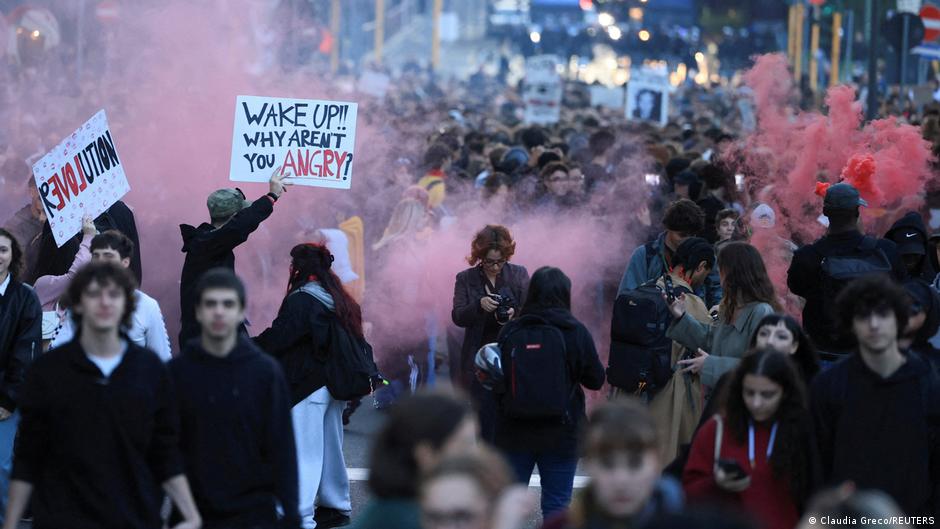
Protests over Italy’s high cost of living continued on Saturday, October 24, as demonstrators opposed rising fuel prices, increased weapons spending and the policies of Prime Minister Giorgia Meloni’s government. The renewed unrest has implications beyond public order, placing pressure on physical retailers, transport infrastructure and the digital systems increasingly used to monitor demonstrations and coordinate economic activity.
Police reported nine arrests and 371 preliminary detentions, including 110 cases involving minors, according to AFP. The figures followed protests on October 17 and 18 that escalated into disorder, prompting authorities to strengthen security measures ahead of the latest demonstrations.
For Italy’s digital economy, the response illustrates how periods of social tension can rapidly expand the role of surveillance technology and online monitoring. Authorities used drones and helicopters to observe the demonstrations, reinforced patrols at railway stations and closely tracked internet activity to identify new calls for unrest.
Economic strain reaches retailers and payment networks
The demonstrations were driven partly by concerns over household expenses and fuel prices, issues that can affect consumer spending and confidence. Although the source reports did not quantify any impact on sales or transactions, disruption in major commercial districts can create immediate operational challenges for merchants, payment providers and digital banks serving affected customers.
In Milan, the protests remained largely peaceful until the evening, according to dpa. Demonstrators later confronted law enforcement in the city center, where police used batons to stop a procession. Fearing further disorder, owners of numerous luxury stores barricaded their windows.
The defensive measures taken by retailers underscore the exposure of high-value shopping districts to street disruption. Even when stores retain access to card terminals, mobile wallets and online sales channels, restricted movement around commercial areas can limit customer traffic, complicate deliveries and shift purchases away from physical locations. For payment companies, such episodes can also produce abrupt changes in transaction patterns that require careful fraud monitoring without disrupting legitimate purchases.
The unrest is testing both physical security in Italy’s commercial centers and the digital infrastructure supporting payments, transport and public communications.
The demonstrations also reached transportation hubs. In Bologna, police used tear gas and water cannons to prevent a column of protesters from approaching the railway station. In Turin, law enforcement officers pushed demonstrators back with shields. Stations are critical nodes not only for passenger movement but also for ticketing platforms, contactless payments and the wider flow of workers and consumers through urban economies.
Online monitoring raises cybersecurity questions
The authorities’ close observation of internet activity adds a technology-policy dimension to the security response. Monitoring online calls for disorder may help officials anticipate threats, but the growing use of digital surveillance also raises broader questions for technology platforms, telecommunications providers and financial institutions about data handling, privacy and the distinction between lawful protest activity and credible security risks.
Financial companies operating during periods of unrest face a related challenge. Banks, fintech platforms and cryptocurrency services must maintain access for legitimate customers while remaining alert to account takeovers, fraudulent fundraising, impersonation and other forms of online abuse that can exploit fast-moving events. The source article did not report specific cyberattacks, payment outages or cryptocurrency activity connected to the demonstrations, but the heightened monitoring environment shows how closely public security and digital infrastructure are now linked.
The use of drones adds another layer to that intersection. Unmanned surveillance can provide authorities with broader situational awareness, while also increasing the volume of sensitive data generated during public events. Secure transmission, storage and access controls are therefore important operational considerations whenever such systems are deployed.
Protests spread across major Italian cities
In Rome, a predominantly pro-Palestinian demonstration moved through the historic center. At one point, participants entered the Colosseum, dpa reported. Protest actions also took place in Naples and Florence, extending the security and economic implications across several of Italy’s largest urban centers.
The geographic spread matters for companies with nationwide operations. Digital banks, payment processors, e-commerce platforms and technology employers depend on resilient communications and transport networks across cities. Localized disturbances may remain manageable, but simultaneous events can increase the need for business-continuity planning, real-time risk assessment and coordination with merchants and customers.
Technology stocks and financial-sector companies can also be sensitive to wider signals about consumer demand, political stability and regulatory policy, even when a single weekend of protests does not produce a measurable market impact. The Italian demonstrations reflect public anxiety over living costs and energy expenses, pressures that influence household budgets and the broader environment in which fintech companies compete for deposits, payments and consumer lending.
With authorities tightening security after the earlier unrest, the latest demonstrations have become both a public-order challenge and a test of digitally enabled monitoring. Their longer-term significance for payments, banking and technology businesses will depend on whether disruption persists and whether economic grievances translate into sustained pressure on consumer activity.