Sanctioned Russian ‘Shadow Fleet’ Tanker Sends Atlantic Distress Signal
The MYRA incident highlights how sanctions screening, digital payments and maritime technology intersect in opaque global oil trading networks.
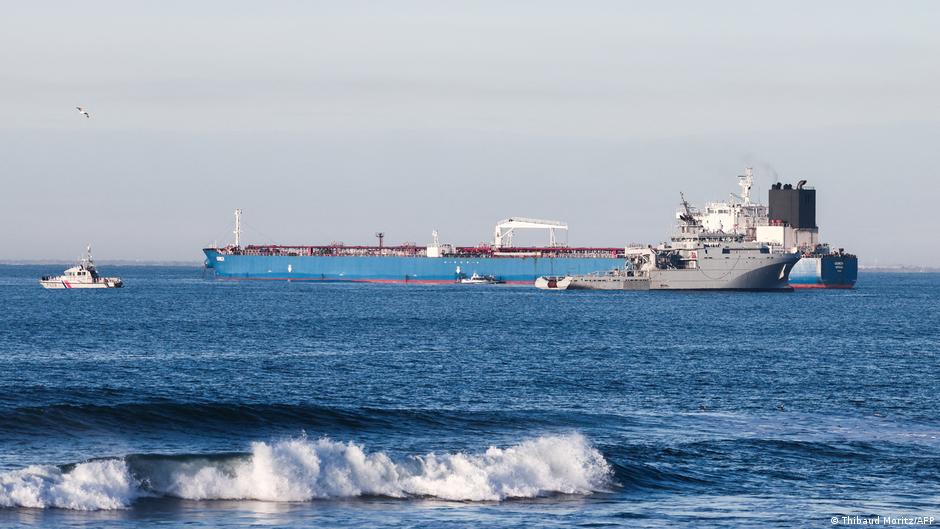
The sanctioned oil tanker MYRA, identified by Ukrainian intelligence as part of Russia’s so-called shadow fleet, has transmitted a distress signal in the North Atlantic off Ireland’s northwestern coast, bringing renewed attention to the financial and technological infrastructure supporting sanctioned energy trade.
Maritime monitoring project SeaNews reported on Saturday, October 24, that the distress alert was sent through the Inmarsat-C satellite communications system. The UK Coastguard is coordinating the response.
According to SeaNews, the 75,000-ton vessel had departed from the Russian port of Ust-Luga and was continuing to travel at about 9 knots, or approximately 17 kilometers per hour, despite extreme weather. Waves in the area reportedly reached 8.8 meters when the alert was transmitted, while wind gusts were about 130 kilometers per hour. The tanker was estimated to be roughly 348 kilometers from the coast.
Sanctions compliance extends beyond the tanker
MYRA is subject to sanctions imposed by the United States, European Union and United Kingdom. Ukraine’s War & Sanctions database, maintained by the Main Intelligence Directorate of the Ukrainian Defense Ministry, says the vessel has been used to export Russian crude oil and petroleum products to third countries while circumventing restrictions.
The Ukrainian agency links MYRA to Fractal Marine DMCC, a company registered in the United Arab Emirates that it describes as one of the leading operators of Russia’s shadow fleet. The intelligence service says the tanker has repeatedly called at the Russian ports of Ust-Luga and Primorsk and has also visited ports in Senegal, Turkey, Brazil, Estonia and Denmark.
War & Sanctions records show that the United States designated the vessel on July 30, 2025, followed by the European Union on October 24, 2025. Switzerland and Ukraine added it to their sanctions lists on December 13, 2025. The United Kingdom followed on February 24, 2026, and Canada on March 25, 2026.
The case illustrates how a maritime emergency involving one sanctioned ship can create compliance questions across payments, insurance, communications and port services.
For banks, payment companies and trade-finance platforms, the vessel’s status is significant because sanctions controls are not limited to direct purchases of oil. Transactions connected to shipping services, fuel, repairs, insurance, port access or emergency assistance can require screening of ships, operators, beneficial owners and counterparties. The source report does not identify any bank, payment processor, insurer or cryptocurrency service involved with MYRA.
The distress alert also underscores the role of satellite technology in a trade ecosystem often characterized by opaque ownership structures. Inmarsat-C provides the communications channel through which the alert was transmitted, while maritime monitoring data can help authorities and commercial compliance teams track vessel activity. In this case, SeaNews reported that the ship remained underway despite the severe conditions.
Ukrainian intelligence alleges an Iran-linked network
Ukraine’s military intelligence says MYRA belongs to a shipping network controlled by Mohammad Hossein Shamkhani. He is the son of Ali Shamkhani, the former secretary of Iran’s Supreme National Security Council and an adviser to the country’s supreme leader. The elder Shamkhani was killed in a joint US-Israeli operation in February 2026, according to the source article.
The Ukrainian intelligence agency alleges that the younger Shamkhani controls a network of tankers, operators and shell companies involved in laundering funds and transporting Russian and Iranian oil, including shipments destined for China. These are claims by Ukraine’s intelligence service; the source article does not provide a response from Mohammad Hossein Shamkhani or Fractal Marine DMCC.
From a digital-economy perspective, the allegations emphasize the challenge facing automated sanctions-screening systems. Vessel names, corporate registrations, operating companies and ownership relationships can form a changing web that financial institutions must assess before processing transactions. The source does not state whether digital assets were used, but opaque cross-border networks are relevant to both conventional banking and crypto compliance because regulated platforms must identify sanctioned entities and prohibited transactions.
The event may also be relevant to technology providers supplying shipping data, satellite connectivity and risk analytics. Accurate vessel identification and updated sanctions records are essential inputs for compliance software used by banks, commodity traders and maritime businesses. No financial losses, pollution, cargo damage or casualties were reported in the source account, and MYRA was still moving when SeaNews described the incident.
The immediate focus remains the safety operation coordinated by the UK Coastguard. Beyond the emergency itself, MYRA’s distress signal offers a visible example of how sanctioned oil shipping connects physical infrastructure at sea with digital communications, cross-border payment controls and increasingly data-driven enforcement.