Georgia Opposition Launches New Protest Wave as Political Risks Mount
The renewed unrest could deepen uncertainty for Georgia’s digital economy, financial sector and international investment outlook.
Georgia’s opposition has declared the start of a new wave of protests against the policies of the ruling Georgian Dream party, adding to political uncertainty that could weigh on the country’s investment climate and its expanding digital economy.
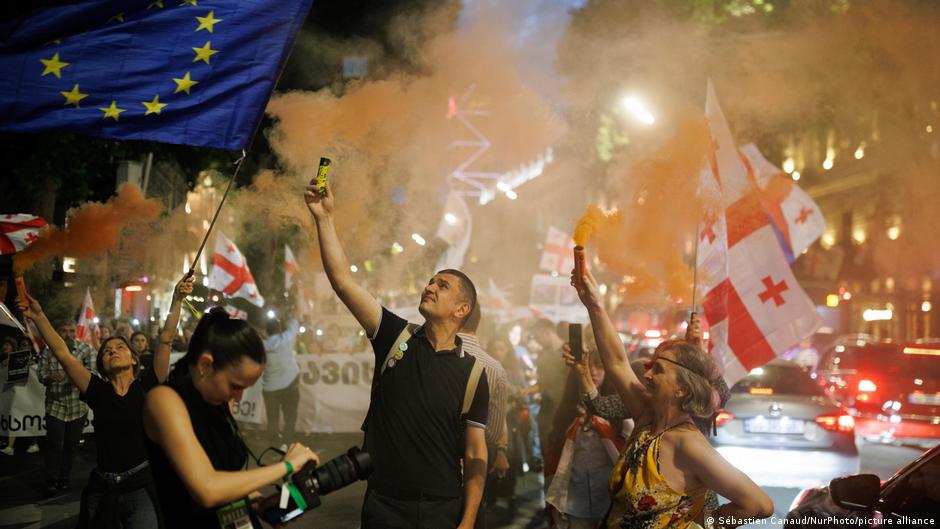
Thousands of people took part in a protest march in Tbilisi on Sunday, October 25, according to Caucasian Knot. The demonstration, held under the slogan “Georgia Without Ivanishvili,” was organized by opposition parties and civil society representatives as Georgia’s Constitutional Court considers a lawsuit seeking to ban opposition parties.
Participants marched from Tbilisi State University toward Rustaveli Avenue, carrying Georgian, Ukrainian and European Union flags. A large contingent of law enforcement officers was also present, the report said.
For investors and financial businesses, the confrontation introduces another layer of political risk at a time when Georgia is seeking to strengthen its position as a regional center for technology, cross-border commerce and digitally delivered financial services. The protest itself was political rather than focused on economic policy, but prolonged instability can affect capital allocation, consumer confidence and the operating environment for banks, payment companies and technology firms.
Opposition Plans Major November 28 Rally
Nika Gvaramia, leader of the Coalition for Change, described Sunday’s march as the beginning of a new protest wave. He said the movement would need to build toward a culmination, potentially on November 28—the second anniversary of the start of mass protests in Georgia—or in the days that follow.
“We are starting today, and we definitely need a culmination, whether it is November 28 or in the following days. It is important that there are very many of us on the 28th, so that the wind cannot extinguish the fire,” Gvaramia said, according to Caucasian Knot.
A large demonstration is planned for November 28. Gigi Tsereteli, leader of European Georgia, who also attended the march, said the country’s democratic deterioration was particularly striking given its previous standing in the process of European integration.
“What is happening in Georgia today in terms of the destruction of democracy and destabilization is truly unimaginable, given that we were a champion country on the path toward European integration and today we are outsiders,” Tsereteli said, according to Georgia Online.
He added that parties were being banned and political life was effectively being restricted, while political prisoners represented another major challenge.
Digital Economy Faces Broader Confidence Test
The Constitutional Court case and the renewed mobilization are likely to be watched closely by financial institutions, fintech operators and technology investors. Political predictability and confidence in the rule of law are important considerations for companies handling payments, customer data and cross-border transactions. Cybersecurity planning can also become more demanding during periods of sustained unrest, when financial platforms, public services and online information channels may face heightened operational pressure.
No disruption to payment systems, digital banks, cryptocurrency services or technology companies was reported in connection with Sunday’s march. Still, the prospect of a prolonged protest cycle may influence how domestic and foreign businesses assess Georgia’s regulatory direction and exposure to political shocks. Technology stocks and publicly traded financial companies with links to the Georgian market could also be sensitive to any deterioration in the broader business environment, though the source report identified no specific market movements.
The renewed demonstrations follow a political crisis that began with mass protests against Georgia’s “foreign agents” law in spring 2024. The protests intensified after Georgian Dream won the parliamentary election. In November 2024, the crisis escalated after the authorities decided to postpone negotiations on Georgia’s accession to the European Union until 2028.
Those demonstrations were accompanied by clashes with police. Authorities dispersed protesters using tear gas and water cannons. The record of confrontation raises the stakes ahead of the planned November 28 rally, particularly for businesses that depend on uninterrupted urban operations, reliable digital infrastructure and stable relations with international partners.
Georgia’s European trajectory is also relevant to its financial modernization. A widening political divide over integration with the EU may shape perceptions of future regulatory alignment, including standards affecting financial supervision, data protection and digital services. The opposition’s latest campaign therefore presents more than a domestic political challenge: it creates a fresh test of confidence in the institutional environment underpinning Georgia’s technology and financial sectors.
With opposition leaders seeking a much larger turnout on November 28, the duration and intensity of the new protest wave will be central to assessments of near-term economic and operational risk. For the country’s banks, fintech businesses, payment providers and technology investors, the immediate question is whether the political confrontation remains contained or develops into another extended national crisis.