Pussy Riot and Femen Protest Russian Pavilion at Venice Biennale Amid Political Controversy
Activists demand representation of Russian political prisoners with pro-Ukrainian views at the Venice Biennale's Russian pavilion.
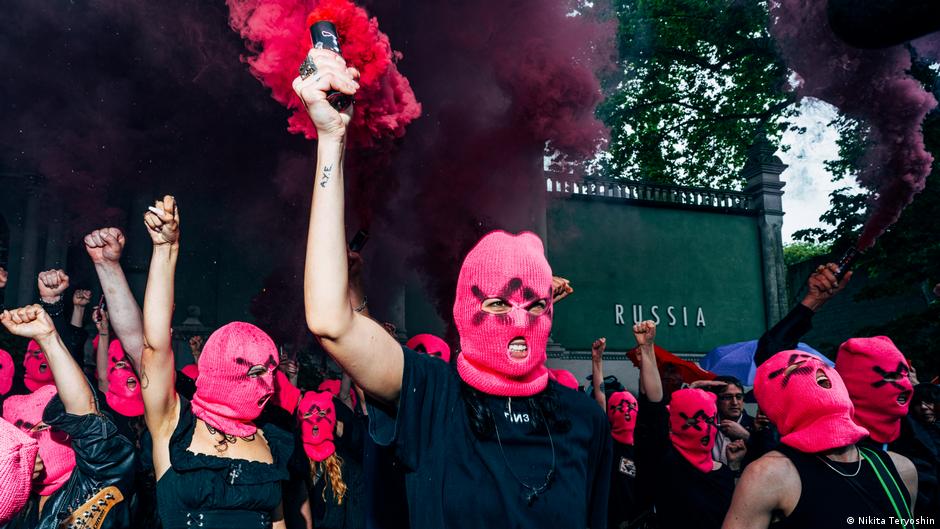
On May 6, feminist punk band Pussy Riot and Ukrainian activist group Femen staged a protest outside the Russian pavilion at the Venice Biennale, demanding that Russia be represented by political prisoners who hold pro-Ukrainian views.
The demonstrators ignited pink, yellow, and blue smoke bombs and chanted slogans such as "Russian art is blood." They held placards with messages including "Enjoy the show - ignore the war," "Curated by Putin, corpses included," and "Art on display, graves below." Some activists painted these phrases on their bodies, and Ukrainian flags and masks were hung on statues near the pavilion.
"The best citizens of Russia are either imprisoned for anti-regime and pro-Ukrainian actions or killed behind bars, while Europe opens its doors to Putin's officials and propagandists," said Pussy Riot member Nadezhda Tolokonnikova. "Those who should represent Russia at the Venice Biennale are artists imprisoned for their anti-war and pro-Ukrainian stance."
Venice Biennale Amid Geopolitical Tensions
This year marks Russia's first participation in the world’s premier contemporary art exhibition since the full-scale invasion of Ukraine began. The organizers’ decision to allow Russia’s pavilion to participate has met sharp criticism from the European Union and Ukraine. The European Commission has stated that this move violates EU sanctions legislation.
In response to the backlash, the Russian pavilion will only be open from May 6 to 8 for invited guests during a continuous sound performance titled "Tree Rooted in the Sky." The pavilion will be closed to the general public starting May 9, when the Biennale opens more broadly. Due to the controversies surrounding the Russian and Israeli pavilions, the Biennale jury has excluded both countries from award nominations and subsequently resigned.
The Russian pavilion is managed by Smart Art, a company founded by Ekaterina Vinokurova and Anastasia Karneeva. Karneeva is the daughter of a retired general and deputy director of Russia’s state defense conglomerate Rostec, while Vinokurova is the daughter of Russian Foreign Minister Sergey Lavrov.
This event underscores the intersection of art, politics, and international sanctions, with ramifications that extend beyond the cultural sphere and into geopolitical and economic sectors, including the digital economy and fintech domains. The controversy highlights how geopolitical conflicts influence cultural events and can impact the reputations and operations of organizations linked to state actors.
In the fintech and digital economy context, such tensions often lead to sanctions impacting financial transactions, digital banking operations, and cross-border payments involving Russian entities. The heightened scrutiny and regulatory measures can affect tech stocks associated with companies linked to state-controlled sectors, including defense and technology firms.