Trump Threatens EU Trade Halt as Canada Partnership Raises Market Risks
The U.S. president warned of steep tariffs or a trade cutoff if EU-Canada cooperation is judged hostile by Washington.
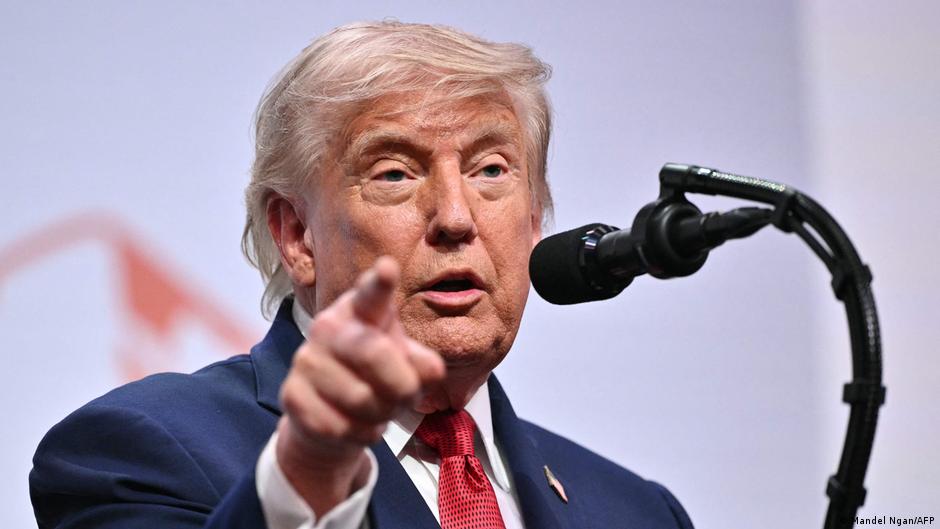
U.S. President Donald Trump has threatened to halt trade with the European Union if the bloc continues expanding its partnership with Canada, injecting fresh uncertainty into transatlantic commerce and the digital economy that depends on stable cross-border rules, procurement access and technology supply chains.
Speaking on Wednesday, September 16, at a campaign event in North Carolina, Trump responded to European Commission President Ursula von der Leyen’s plan to make Canada the EU’s “first associate member.” He called the proposal “ridiculous” and warned that Washington could answer with sharply higher tariffs if it sees the initiative as unfriendly.
“If they do that and I consider it, even to the slightest degree, an unfriendly act, I will impose very high tariffs or stop trade with Europe,” Trump said.
Trump added that the outcome would depend on intent. “If the intentions are good, everything is fine. If the intentions are bad, we will put very high tariffs on Europe, that is one of the possibilities,” he said.
For financial markets, the threat broadens an already tense trade landscape. A disruption in U.S.-EU commerce would touch far more than goods. Banks, payment networks, cloud providers, chip suppliers, cybersecurity vendors and technology companies all rely on predictable transatlantic flows of services, hardware and regulatory cooperation. Even without immediate policy action, the prospect of tariffs or a trade cutoff can affect corporate planning, valuations of tech stocks and investor appetite for companies exposed to North American and European markets.
Technology Cooperation Moves Into the Trade Crossfire
Von der Leyen outlined the EU’s ambitions on September 16 in the European Parliament, where Canadian Prime Minister Mark Carney was present. She said the European Union wants to raise its relationship with Canada to the “highest possible level” and that she and Carney want to work so that “Canada becomes the first associate member of the EU.”
She did not provide details on what such a partnership would contain. But she did mention cooperation in technology and the defense industry, two sectors that carry direct consequences for the digital economy. Technology cooperation between Canada and the EU could involve areas central to financial infrastructure, including data governance, secure communications, artificial intelligence, cloud services and cyber resilience, though von der Leyen did not specify any such measures in the remarks cited.
Von der Leyen stressed that joint work between Canada and the EU “will not be directed against others” and that its goal would be to make both sides stronger. That assurance did not prevent Trump from framing the prospective arrangement as something Washington may judge through the lens of trade hostility.
The dispute comes as Canada and the EU are both dealing with what AFP described as the unpredictable trade and foreign policy of Trump’s administration. That is why, according to the agency, Canada and the European Union are looking at new alliances.
Payments, Procurement and Digital Banking Exposure
The immediate measures announced by Washington are focused on government procurement and goods tariffs, but they matter for fintech and digital banking because public-sector access is often a gateway for technology providers. The White House said Trump signed a memorandum on September 16 banning Canadian goods from participation in U.S. federal government procurement. According to the release, Washington is taking the measures in response to Canada, which it said had “unreasonably introduced new barriers” for American companies seeking access to the public procurement market.
If procurement restrictions widen or become reciprocal, digital service providers could face a more fragmented operating environment. Banks and fintechs often depend on hardware, secure cloud infrastructure, compliance software and identity systems that are sourced through complex supplier networks. Tariffs on inputs such as steel, aluminum, paper, furniture and lighting may appear distant from payments at first glance, but higher costs across office infrastructure, data centers, branch networks and logistics can still filter into corporate budgets.
Since September 15, the Trump administration has imposed additional 50 percent tariffs on cheese, steel, aluminum, paper, furniture, lighting fixtures and other goods from Canada. Administration representatives said the move was a direct response to Ottawa’s introduction of new tariffs.
Canada’s tariffs on U.S. exports worth about $20 billion took effect on September 15. Those measures were a response to U.S. tariffs of 50 percent on Canadian goods worth $20 billion that came into force on August 22. Canada withdrew from trade talks with the United States on August 21.
The escalation creates a risk map that extends across financial technology. Payment companies watch trade disputes because cross-border commerce is a volume driver. Digital banks monitor them because customers, particularly small businesses, can be hit by higher import costs and supply uncertainty. Cybersecurity companies may see demand supported by the political sensitivity of technology alliances, but procurement barriers can also limit market access. Crypto markets, often sensitive to macro and geopolitical volatility, could respond indirectly if investors reassess currency, inflation or risk expectations, though the source material does not report any immediate crypto market reaction.
For technology stocks, the larger issue is uncertainty. The EU-Canada initiative remains undefined, and Trump’s response is conditional on whether he interprets the partnership as hostile. That leaves investors with a familiar problem: policy risk that cannot yet be priced cleanly, but which could reshape trade flows among three major advanced economies if rhetoric turns into broader restrictions.