Putin Says Armenia’s EU Membership Bid Would Mean Exit From EEU
Moscow and Yerevan clashed over whether Armenia’s EU accession process is compatible with its obligations inside the Eurasian Economic Union.
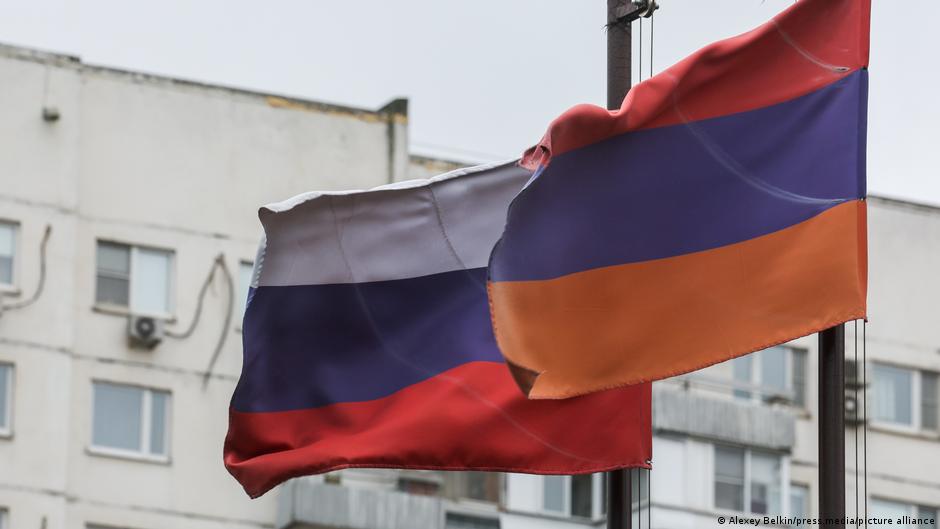
Russian President Vladimir Putin told Armenian Prime Minister Nikol Pashinyan that Armenia’s move to begin the process of joining the European Union would in practice amount to leaving the Eurasian Economic Union, sharpening a dispute with implications for regional trade rules, payments flows and the broader digital economy.
The two leaders met on the sidelines of the Shanghai Cooperation Organisation summit in Bishkek. According to a transcript published on the Kremlin website on Tuesday, September 1, the central topic of the talks was Yerevan’s plan to submit an application to join the EU.
Putin said Armenia could not remain inside both blocs at once. In remarks addressed to Pashinyan, he argued that adopting a law to begin accession to another economic organisation effectively constituted a declaration of withdrawal from the EEU because, in his view, membership in both structures is incompatible.
“You said that you did not declare withdrawal. The adoption of a law on the start of the procedure for joining another economic organisation in fact means a declaration of withdrawal from ours, because being there and there is incompatible. That is the problem,” Putin said.
Putin was referring to the European Union as the “other organisation” and the Eurasian Economic Union as “ours.” He again called for a referendum in Armenia on the choice between the EU and the EEU, saying the authorities should ask the public directly.
Pashinyan rejected the suggestion that Armenia had breached any of its commitments. He said Yerevan had analysed the treaty framework governing relations between Russia and Armenia, as well as the legal basis operating within the EEU, and had found no violations of Armenia’s obligations to Russia or the bloc.
The Armenian prime minister added that, with the adoption in 2025 of a law on European integration, Armenia had in effect moved away from the idea of holding a referendum on choosing between the EU and the EEU.
Why the dispute matters for the digital economy
While the exchange was political on its surface, the argument goes to the architecture of economic alignment in a region where trade regimes, customs procedures and market access increasingly shape financial technology and cross-border digital services. For banks, payment providers and technology firms, Armenia’s orientation matters because the EEU framework and the EU framework are built around different regulatory logics.
If Armenia advances an EU track while remaining in a dispute with Moscow over EEU compatibility, businesses exposed to the country could face a period of uncertainty around market rules, compliance and transaction infrastructure. That matters for payment companies handling regional merchant flows, digital banks serving importers and exporters, and cybersecurity teams monitoring rising geopolitical friction. Even without any immediate formal change in Armenia’s status, signals from Moscow can affect business expectations.
The issue is especially relevant for payment systems and digital commerce because trade alignment often influences settlement practices, standards and the ease of moving goods and services across borders. For fintech investors, the dispute is another example of how geopolitics can shape the commercial environment for digital finance in smaller but strategically located markets.
Pashinyan first announced on August 24 that Armenia intended in the near future to begin the process of applying for EU membership. After that statement, the European Commission said Armenia was now “closer to the European Union than ever,” while also stressing that accession takes place through a clearly defined, merit-based process.
That response suggested political openness from Brussels without changing the formal conditions for membership. From a market perspective, it also underscored that any Armenian move toward the EU would be gradual rather than immediate, leaving a potentially prolonged period in which businesses would need to watch both Brussels and Moscow for signals.
In June, Pashinyan had said there were no grounds for holding a referendum on joining the European Union. He was responding to a joint statement by the leaders of Russia, Belarus, Kazakhstan and Kyrgyzstan. Putin had previously maintained that EU and EEU membership could not be combined. The Russian president also said earlier that the so-called “Ukrainian scenario” began with Kyiv’s attempt to join the EU.
For financial markets, that rhetoric raises the risk that political disagreements could spill into commercial pressure. Before Armenia’s parliamentary elections on June 7, Moscow increased pressure on Yerevan, including by banning the import into Russia of a number of Armenian products. Pashinyan’s Civil Contract party went on to win those elections.
The use of trade restrictions is closely watched by companies involved in logistics, payments and supply-chain finance, because goods bans can quickly ripple into invoicing, working capital and foreign-exchange needs. Even when targeted at physical imports, such measures can have secondary effects on the digital economy by altering transaction volumes and raising operational risk for platforms that serve affected businesses.
Pashinyan and Putin met in person in Bishkek on September 1 for the first time since those elections. The encounter highlighted how Armenia’s European ambitions are now colliding more directly with Russia’s effort to preserve the coherence of the EEU.
For tech-focused investors, the immediate takeaway is less about a sudden policy break than about regulatory uncertainty. Armenia is being pulled between two economic systems, and the debate over compatibility could influence everything from trade-linked payment corridors to the compliance posture of banks and financial technology firms. It may also sharpen cybersecurity concerns if geopolitical tensions translate into greater pressure on digital infrastructure and cross-border commercial systems.
No immediate institutional outcome emerged from the Bishkek talks. But the exchange made clear that Moscow sees the start of Armenia’s EU accession path not as a symbolic gesture, but as a strategic choice with consequences for its place in the Eurasian economic order.