Uzbekistan ID Card Fees Raise Questions Over Cost of Digital Access
A viral account of a family's struggle to pay for a teenager's first ID card has widened scrutiny of a state fee that also shapes entry into digital services.
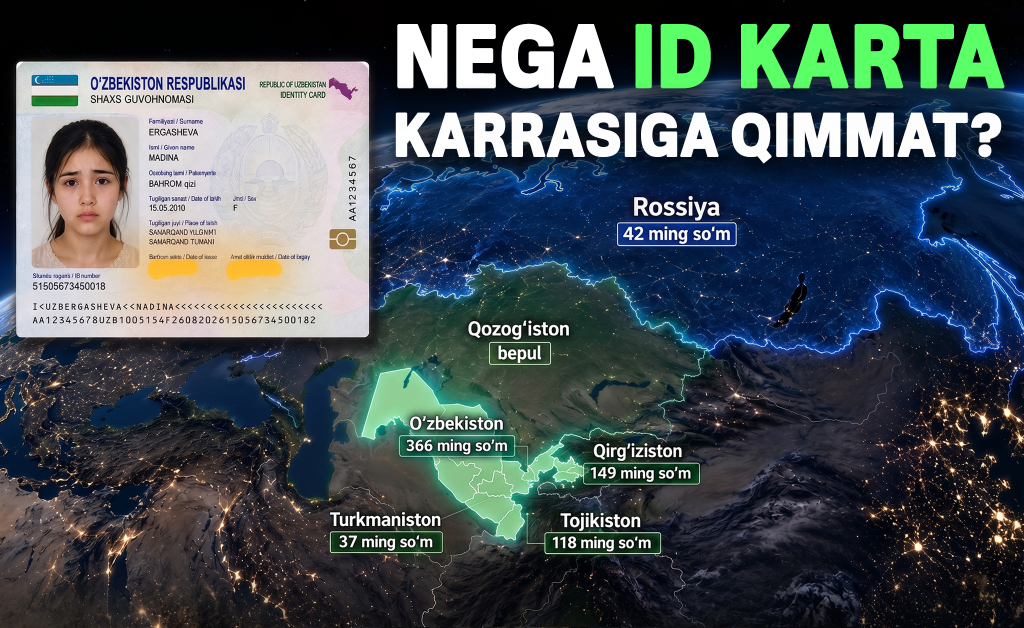
In Uzbekistan, the price of a teenager's first identity card has become a flashpoint in a broader debate over affordability and digital access. For the fintech sector, the issue reaches beyond paperwork: a state-issued ID is the basic credential that allows citizens to move through online public services and into the formal digital economy.
The discussion intensified on social media after journalist Dilnoza Qurbonova described what she saw at a passport office: a 15- or 16-year-old girl standing with her parents to obtain her first ID card. Qurbonova wrote that the family's clothes and expressions reflected hardship, and that the father's hands began to shake when he was told how much had to be paid at the cashier.
He opened his wallet and started counting even the last small coins one by one. In those seconds, seeing the father's anguish, and the daughter's eyes first turn to her father and then to the ground, made my heart ache.
That account pushed a simple question into public debate: how fair is the state duty charged for the first proof of identity in a young citizen's life, and how do other countries handle the same moment? Vaqt.uz reviewed pricing across eight countries to compare what citizens pay for a first identity document.
How the fee works in Uzbekistan
In Uzbekistan, the cost of a first ID card depends on how the application is submitted. If the application is filed through a migration office, a public services center or a consulate, the state duty is set at 89% of the base calculation amount, or BHM. With the BHM currently at 412,000 soums, that puts the fee at 366,680 soums.
If the application is submitted online through my.gov.uz, the fee is set at 80.1% of the BHM, which currently comes to 330,012 soums. The online channel is therefore cheaper, a notable detail in a debate that touches digital access as well as household budgets.
The BHM has been set at 412,000 soums since August 1, 2025. From September 1, 2026, it will increase to 440,000 soums. If the current fee rates remain unchanged, the state duty for a first ID card will rise to 391,600 soums for applications filed through a migration office, public services center or consulate, and to 352,440 soums for applications filed through my.gov.uz.
For fintech observers, the significance lies in the identity layer that underpins onboarding, digital payments and secure online verification. The controversy does not center on banks or crypto directly, but it does concern a foundational requirement for participation in digital services.
Regional comparisons sharpen the affordability debate
Uzbekistan ties the fee to the base calculation amount, but several neighboring countries use different rules. In Kazakhstan, from January 1, 2026, every citizen who turns 16 can receive an ID card for the first time free of charge, and renewal after expiry is also free. The same fee waiver also applies to people receiving the document for the first time after age 18, to those acquiring Kazakh citizenship and in certain other cases. The initiative is aimed at reducing the financial burden on citizens and simplifying the documentation process.
In Kyrgyzstan, a first ID card can be issued under the standard procedure within 12 working days for 1,103 Kyrgyz soms. At the current exchange rate, that is about $12.6, or 149,000 Uzbek soums, making it roughly 2.5 times cheaper than Uzbekistan's current 366,680-soum state duty.
In Tajikistan, the fee for an ID card is set at $10, collected in somoni at the exchange rate on the day of payment. The processing time is up to 15 days. At the Central Bank of Uzbekistan's official August 21 exchange rate, $10 is about 118,000 Uzbek soums, or roughly 3.1 times cheaper than the Uzbek fee cited in the debate.
Turkmenistan does not have a separate national ID card; the main identity document is a biometric passport. According to the State Migration Service, the state duty for that document is 60 manats. At the black-market exchange rate cited in the comparison, that is about $3.2 or 37,000 Uzbek soums. Children under 16 are exempt, which makes the cost about 10 times lower than the fee currently charged in Uzbekistan.
In Russia, citizens receive an internal passport at age 14. The state duty for first issuance is set at 300 rubles, or about $3.6 and 42,000 Uzbek soums at the current exchange rate, making it roughly 8.7 times cheaper than Uzbekistan's current first ID card fee. Under Russia's tax code, the same 300-ruble duty applies when the passport is first issued and when it is replaced under the standard procedure. If the passport is lost or becomes unusable, the fee rises to 1,500 rubles.
In Turkey, the main identity document is the Türkiye Cumhuriyeti Kimlik Kartı. In 2026, the set price is 220 Turkish lira, equivalent to about $5 or 59,000 Uzbek soums. But if a child's birth is registered within the legally defined period and the first identity card is issued on that basis, no fee is charged. A card issued after the deadline or for replacement costs 220 lira.
In Azerbaijan, identity cards are issued from age 15. According to the interior ministry, the standard 10-day procedure carries a state duty of 5 manats.
For Uzbekistan's policymakers, the comparison does not settle the debate, but it does clarify the pressure point. The state has already created a cheaper digital route through my.gov.uz, yet the wider question raised by the viral post is whether the first credential of citizenship should be priced as a barrier at all. For digital banking, payments and other verification-heavy services, affordability at the first step can influence how quickly people enter formal and secure online systems later on.