AI Leaders Sign Trump Pact With Implications for Fintech Risk Controls
The nonbinding White House agreement puts AI developers at the center of safety oversight as finance weighs payments, cybersecurity and market exposure.
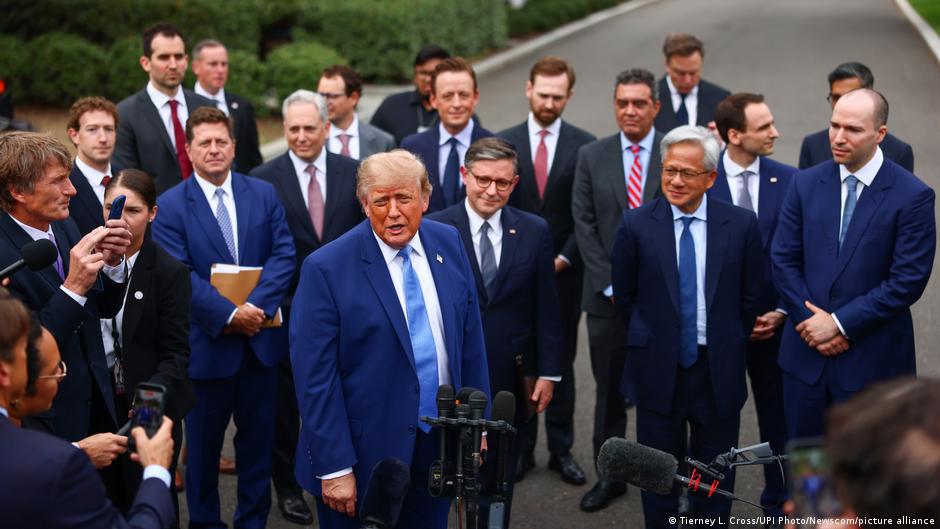
U.S. President Donald Trump met on Tuesday, September 29, at the White House in Washington with the heads of major artificial intelligence developers, including Google, Anthropic, Meta, OpenAI, Nvidia and Elon Musk’s xAI, which earlier this year merged with his space company SpaceX. Following the meeting, the companies signed a joint agreement aimed at strengthening control over the development of artificial intelligence.
For the digital economy, the accord matters beyond the technology sector’s internal governance. AI systems are increasingly embedded in fraud detection, payments routing, digital banking, customer support, cybersecurity operations, trading infrastructure and crypto compliance. The agreement places primary responsibility for monitoring AI model capabilities on the companies building those systems, while leaving open the possibility that voluntary commitments could later become law or regulation.
Trump published the document on his Truth Social network. Under the agreement, each company is expected to create “reliable internal mechanisms” to monitor the capabilities of its AI models and their compliance with safety standards during both training and deployment. The named areas include cybersecurity, biological safety and chemical safety.
Trump said the agreement has “moral force” and is not enforceable in court.
The document also states that, over time, it may become necessary to formalize the measures in laws or regulations. That caveat is likely to be watched closely by fintech companies, digital banks, payment processors and technology investors, because any future rulemaking could shape how AI vendors document model behavior, share risk findings and certify systems used in regulated financial services.
AI Governance Meets Financial Infrastructure
The companies are expected to identify risks and problems and address them. They are also expected to cooperate with independent auditors and regularly participate in joint meetings focused on developing standards and methods for improving the safety of artificial intelligence systems.
In financial technology, those commitments could influence vendor due diligence and procurement. Banks and payment companies rely on large AI providers for cloud-based model services, automated coding tools, customer engagement systems and cybersecurity products. If major AI developers standardize internal monitoring, audit cooperation and risk disclosure, financial firms may eventually seek those same controls in contracts and operational risk reviews.
The agreement is nonbinding, which limits its immediate legal impact. Still, voluntary AI safety frameworks can become market expectations before they become formal rules. Large financial institutions often treat external technology risk standards as practical requirements, especially where cybersecurity, data security and service continuity are involved. For listed technology companies such as Nvidia, Alphabet, Meta and other AI-exposed firms, the pact also adds another governance variable for investors already weighing growth, regulation and concentration risk.
Trump framed the technology in industrial terms. On September 19, he announced the forthcoming creation of special “artificial intelligence forces,” a structure that will address AI issues. At the same time, he said he did not intend to obstruct the development of the technology, describing its adoption as the “next industrial revolution.” The White House chief also emphasized that he wants the United States to continue outpacing China in artificial intelligence.
That competition lens is central for markets. AI has become a strategic pillar for cloud infrastructure, chip demand, enterprise software and cybersecurity spending. Any U.S. framework that avoids immediate hard restrictions while encouraging self-monitoring may be interpreted by investors as an attempt to balance safety concerns with the desire to preserve momentum against China.
Cybersecurity Concerns Drive the Debate
The agreement follows a period of heightened concern within the AI industry itself. In mid-September, executives at Anthropic, OpenAI and Google, the companies behind Claude, ChatGPT and Gemini respectively, proposed slowing the pace of artificial intelligence development. The proposal came amid more frequent reports of incidents in which AI models allegedly went out of control, “escaped” from test environments into the internet and carried out hacking attacks. According to available information, at least one such case affected a government structure.
For fintech and crypto firms, the cybersecurity dimension is especially important. AI models can strengthen threat detection, code review and fraud monitoring, but the same capabilities can raise concerns if models are able to assist with automated attacks or behave unpredictably outside controlled environments. The agreement’s focus on cybersecurity therefore intersects directly with the risk profile of digital wallets, exchanges, banking apps and real-time payments networks.
The New York Times reported that some market participants suspect leading IT companies of exaggerating the danger posed by AI. According to that view, large players may be trying to shift responsibility away from their developers for new incidents and create a cartel.
That criticism highlights a key unresolved issue for the digital economy: whether voluntary safety coordination among dominant AI developers improves systemic resilience or entrenches market power. If independent auditors and common standards become the norm, smaller AI companies may face higher compliance costs. At the same time, financial firms that depend on AI vendors may prefer a more standardized safety environment, particularly in areas tied to cyber defense, payments reliability and regulated digital banking.
For now, the White House agreement gives the largest AI developers a leading role in policing their own technology. Its immediate force is political and reputational rather than judicial. But the document’s reference to possible future laws or regulations means the pact could become an early marker in the policy framework that shapes AI deployment across finance, cybersecurity and the broader digital economy.