Canada Seeks Role in EU Ukraine Loan as Digital Trade Ties Deepen
Ottawa is negotiating participation in a €90 billion EU loan for Ukraine while pursuing AI and digital trade agreements with Brussels.
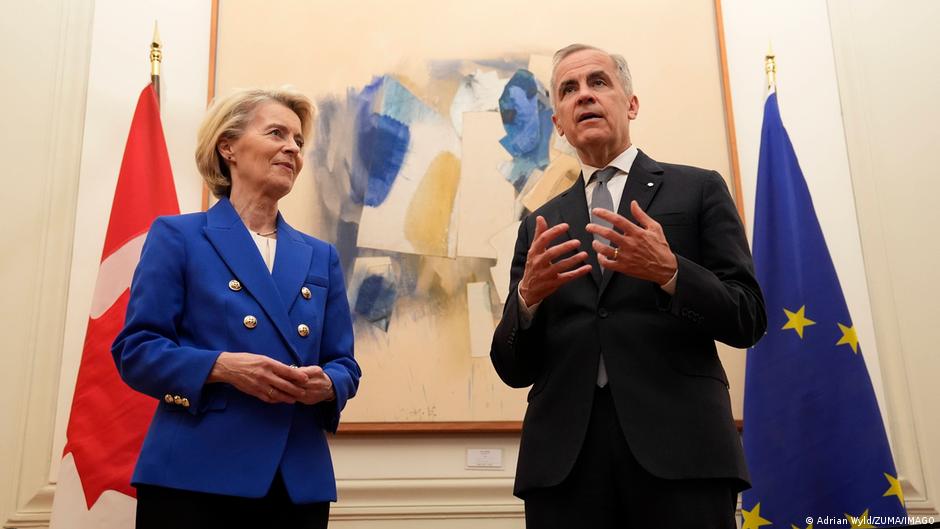
Canada is seeking to join the European Union’s €90 billion loan program for Ukraine, a move that would extend Ottawa’s financial role in Kyiv’s wartime support architecture while reinforcing a broader push into digital and economic cooperation with Europe.
According to the Financial Times, which cited people familiar with the matter, Canada is in talks with the EU over participation in the loan facility. The parties intend to agree on the size of Canada’s contribution before the EU-Canada summit scheduled for late October in Montreal.
The initiative places Canada alongside a European financing effort designed to sustain Ukraine as the war continues to impose large fiscal, defense and infrastructure costs. For financial markets and the digital economy, the talks also matter because they are taking place alongside Ottawa’s effort to deepen ties with Brussels on artificial intelligence, digital trade and advanced computing capacity.
For Prime Minister Mark Carney, Canada’s possible role in the loan program is also a geopolitical signal. The Financial Times reported that Carney wants to demonstrate to Europe his commitment to strengthening transatlantic ties as he seeks to reduce Canada’s dependence on the United States. The newspaper described his idea as building an alliance of liberal powers committed to a multilateral order that it said had been disrupted by U.S. President Donald Trump.
Canada and the European Union are aiming to settle the size of Ottawa’s potential contribution before the EU-Canada summit in Montreal at the end of October.
Financing Ukraine and Rewiring Alliances
So far, the United Kingdom remains the only non-EU country to have joined the loan. Canada’s entry would therefore widen the group of external partners backing the EU-led financing channel and could give the program additional political weight beyond Europe’s borders.
Ottawa has already provided Ukraine with military assistance worth 6.5 billion Canadian dollars, or about 4.7 billion U.S. dollars. On September 10, Carney and Ukrainian President Volodymyr Zelensky signed a declaration on a 100-year partnership that includes, among other areas, cooperation in defense innovation.
That defense innovation component is important for the technology sector. Ukraine’s wartime economy has accelerated demand for secure communications, battlefield software, drones, data systems and cyber defense. While the source report does not specify new technology funding under the proposed loan talks, Canada’s parallel commitment to defense innovation points to a wider policy environment in which public finance, security technology and digital resilience increasingly overlap.
The potential Canadian contribution also lands at a time when governments are using sovereign credit, trade policy and technology cooperation as tools of strategic alignment. For digital banks, payment companies and fintech platforms that operate across borders, the direction of travel matters: closer Canada-EU coordination can influence standards around data flows, digital identity, sanctions compliance, cybersecurity and transaction monitoring.
Digital Trade, AI and Supercomputing
Canada is also hoping to secure other agreements with the European Union as it seeks support in its trade conflict with the United States, the Financial Times reported. Among the possible arrangements are Canadian participation in the EU’s supercomputer network for joint work on artificial intelligence and a digital trade agreement with Brussels.
For the digital economy, those talks may prove as consequential as the Ukraine loan itself. Access to EU supercomputing infrastructure would connect Canada more deeply to European AI research capacity. A digital trade agreement could affect how companies move data, deliver cloud services, authenticate users and scale cross-border software products between Canada and the EU.
Such agreements would be especially relevant for fintech firms operating in payments, digital banking, crypto infrastructure and cybersecurity. Cross-border digital trade rules can shape the cost and complexity of compliance, particularly when firms must satisfy privacy, anti-money-laundering and operational resilience requirements in multiple jurisdictions.
Payments companies could be among the first to watch the contours of any Canada-EU digital trade deal. Clearer rules on data governance and digital services may reduce friction for providers that support international transfers, business-to-business settlement, card processing or embedded finance products. At the same time, deeper alignment with Europe may require Canadian firms to adjust to EU-style regulatory expectations on consumer protection, data handling and security controls.
Crypto businesses would likely read the talks through a similar lens. The source report does not mention cryptocurrency directly, but any broader Canada-EU digital framework could influence how digital asset firms approach compliance architecture, custody, transaction screening and market access. Europe has moved toward more formalized crypto regulation, and closer Canadian engagement with Brussels could encourage greater interoperability between regulatory approaches over time.
Cybersecurity is another likely area of market attention. Ukraine-related financing, defense innovation cooperation, AI research and digital trade all depend on resilient networks and secure infrastructure. As governments expand digital cooperation, financial institutions and technology providers may face rising expectations for incident response, secure software supply chains and protection against state-linked cyber threats.
Market Implications
For technology stocks, the immediate implications are political rather than numerical. The report does not provide the size of Canada’s potential contribution or name specific corporate beneficiaries. Still, the direction of Canadian policy suggests a stronger emphasis on strategic technology partnerships with Europe, particularly in AI infrastructure, defense innovation and digital commerce.
Companies exposed to cloud services, AI computing, cybersecurity, defense technology and regulated financial infrastructure may monitor the EU-Canada summit for signs of procurement priorities, research funding or regulatory convergence. Any confirmed Canadian contribution to the Ukraine loan would also reinforce the view that public finance remains central to the economic architecture supporting Ukraine and, by extension, the technology systems needed to sustain government, banking and defense operations under wartime pressure.
The late-October summit in Montreal is now the next key date. By then, Ottawa and Brussels aim to determine Canada’s role in the EU loan program. The same diplomatic track could also clarify whether Canada will join the EU supercomputer network and whether a digital trade agreement with Brussels is ready to advance.
For FinPulse readers, the story is not only about another Ukraine financing package. It is also about Canada positioning itself inside a European-centered digital and financial order, where credit, AI infrastructure, payments regulation and cybersecurity are becoming parts of the same strategic conversation.