German Protests Against AfD Highlight Political Risk for Digital Economy
Demonstrations across more than 35 German cities underscored how political polarization may shape regulation, investor sentiment and digital policy.
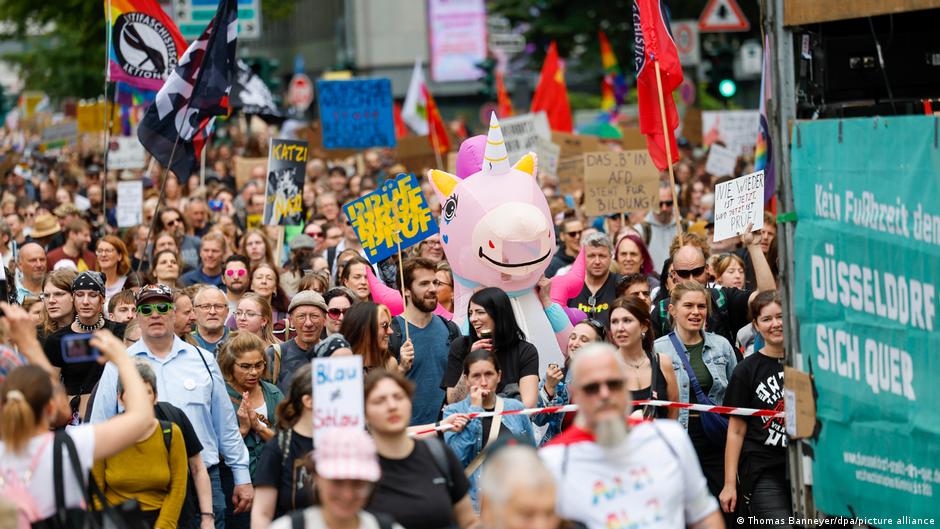
Tens of thousands of people demonstrated across Germany on Saturday, September 12, in protests against right-wing extremism, an expression of civic pressure that arrives at a sensitive moment for Europe’s largest economy and one of its most important digital markets.
The rallies took place in more than 35 German cities and were organized by more than 100 associations. They followed one week after the far-right Alternative for Germany, or AfD, won a state election in Saxony-Anhalt. For fintech companies, digital banks, payment providers, crypto firms and technology investors, the demonstrations are not only a political story. They also point to a broader question: how Germany’s political direction could affect trust, regulation and the operating climate for the digital economy.
In Hamburg, organizers estimated that 25,000 people joined the protest. In Düsseldorf, about 20,000 people took part, a figure also confirmed by local police. In Berlin, law enforcement estimated turnout at 18,000. Public broadcaster ARD estimated 12,000 participants in Munich, while around 2,000 people protested in Mainz.
Smaller demonstrations were reported in other regional centers. In Magdeburg, the capital of Saxony-Anhalt, about 1,100 people joined the rally. In Saarbrücken, turnout was around 1,500. Several hundred people demonstrated in Erfurt. In Schwerin, the capital of Mecklenburg-Western Pomerania, where local elections are due in a week and where polls also show the AfD leading, several dozen people took part.
Digital Economy Watches Political Stability
Germany is a central market for European banking technology, payments infrastructure, cloud services and cybersecurity policy. Political volatility can influence how companies assess regulatory risk, talent mobility, data governance and consumer confidence. While the demonstrations were focused on right-wing extremism and democratic safeguards, the underlying issue of institutional stability is closely watched by investors and technology operators.
Digital finance depends heavily on public trust. Banks, payment processors and crypto platforms all operate in an environment shaped by regulatory enforcement, anti-money laundering rules, consumer protection and cybersecurity supervision. Any shift in Germany’s political consensus could therefore matter for companies that rely on predictable rules across the European Union.
Several demonstrations, including those in Munich, Mainz, Saarbrücken and Magdeburg, were held as part of the Prüf campaign. The campaign promotes a demand for thorough scrutiny of parties classified by Germany’s Federal Office for the Protection of the Constitution, known as the BfV, as “suspected” of right-wing extremism or as “definitely right-wing extremist.” The German word “Prüf” means “check,” and organizers present it as an abbreviation for Prüfung Rettet Übrigens Freiheit, meaning “checking, by the way, saves freedom.”
“Checking, by the way, saves freedom.”
That message has direct resonance for sectors built around verification and compliance. The fintech and digital banking industries are accustomed to know-your-customer procedures, fraud monitoring, sanctions screening and cybersecurity audits. In the political sphere, the protesters’ demand was different but similarly centered on institutional review: a call for closer examination of parties deemed extremist by the constitutional protection authority.
At the rallies, participants called for the launch of proceedings to ban the AfD. In May 2025, the BfV classified the AfD as right-wing extremist at the federal level. However, that classification is not currently in effect because of a lawsuit filed by the party.
In Düsseldorf, demonstrators marched under the slogan “No step back! Against the AfD and right-wing agitation” (“Kein Schritt zurück! Gegen die AfD und rechte Hetze!”). In Hamburg, the slogan was “Time to act — freedom must be defended” (“Zeit zum Handeln - Freiheit muss verteidigt werden”).
Polls Show Divided Public Opinion
The protests also came as polling showed the German public divided over how to respond to the AfD. A survey by the INSA opinion research institute, conducted on September 10 and 11, found that 42% of respondents supported the idea of banning the AfD, while 45% opposed it.
The same poll showed that nearly half of Germans, 46%, opposed the “firewall” policy toward the AfD, under which other parties refuse to cooperate with it. Thirty-four percent supported maintaining the barrier, while 20% were undecided.
For markets, the significance of such numbers lies in the uncertainty they reveal. Technology stocks and digital finance businesses can be sensitive to political narratives around regulation, migration, labor markets and European integration. Germany’s technology sector relies on cross-border capital and specialized talent, while its fintech firms often scale through European passporting rules and harmonized EU frameworks.
The source material does not indicate any immediate market reaction, payment disruption, crypto movement or technology stock response linked to the demonstrations. Still, the protests add to the political context in which companies and investors are assessing Germany. A fragmented electorate and intensifying debate over the AfD could affect expectations for future policymaking, even before any concrete legislative changes occur.
Cybersecurity and digital governance are also part of the wider backdrop. Germany’s constitutional and security institutions play a role in monitoring extremist threats, while digital platforms, banks and payment companies face their own obligations to counter fraud, abuse and illicit finance. The current debate over scrutiny of political organizations does not alter those obligations, but it reinforces how questions of trust and institutional resilience extend from public life into the digital economy.
The demonstrations showed that opposition to right-wing extremism remains highly visible across major German cities. They also highlighted the political stakes facing Germany as regional elections, legal challenges and public opinion converge. For FinPulse readers, the core issue is not only who marched, or where, but what the mobilization says about the stability of one of Europe’s key markets for digital banking, payments, crypto oversight and technology investment.