Trump Says U.S. Will Drop Tariff on Irish Whiskey Imports
The proposed removal of a 10 percent duty may ease a narrow but visible trade pressure point between the United States and Ireland.
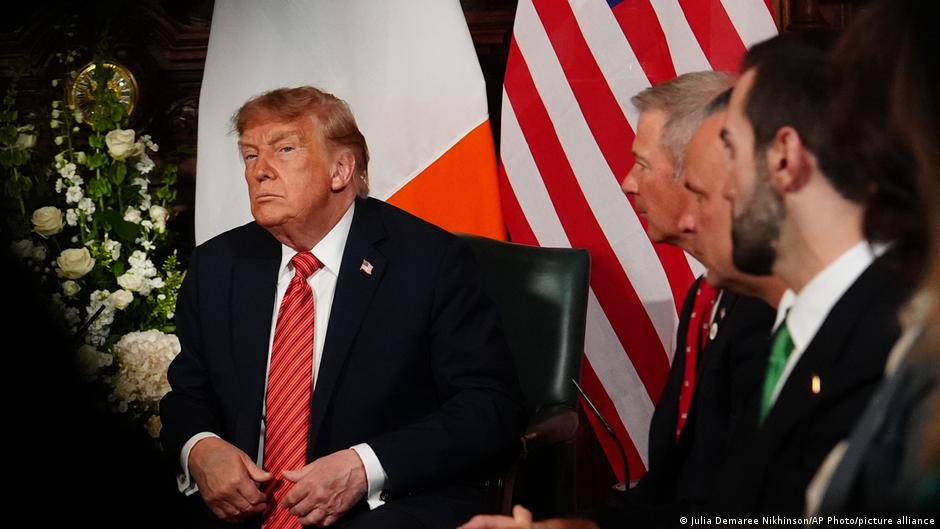
U.S. President Donald Trump said at the end of a visit to Ireland that a 10 percent tariff on Irish whiskey imported into the United States will be abolished, a move welcomed by Ireland’s whiskey industry and closely watched by businesses exposed to transatlantic trade frictions.
Trump made the announcement on Sunday, September 13, in Ireland before a cheering crowd of Irish golf fans during a tournament held at a golf club owned by his family. According to the president, he agreed to numerous requests to remove the U.S. import duty on Irish whiskey.
The announcement gives a high-profile consumer goods example of how targeted tariff decisions can affect cross-border business flows, pricing systems and the broader operating environment for companies moving goods, money and data between the European Union and the United States. While the measure concerns spirits rather than digital services, the decision lands in a trade environment where payment processors, digital banks, compliance platforms and online retailers all have to adapt quickly to changing rules on duties, customs costs and international settlement.
Trade Relief With Digital Economy Implications
Trump said that Irish Prime Minister Micheal Martin and leading Irish golfer Shane Lowry were among those who had asked him to cancel the tariff introduced by Washington. The duty is currently levied as part of tariffs that apply to all exports of wine and spirits from the European Union to the United States.
For importers, distributors and hospitality businesses, the removal of a tariff can feed directly into invoicing, inventory planning and consumer pricing. In the digital economy, those changes are typically reflected first in enterprise resource planning systems, payments reconciliation tools and cross-border accounting software. Any formal implementation of the tariff reversal would require companies to update customs classifications, duty calculations and payment workflows tied to shipments entering the U.S. market.
The Irish Whiskey Association welcomed the president’s statement. In a statement, IWA director Eoin O Cathain said that nothing better characterizes the trade relationship between the United States and Ireland than Irish whiskey. The association also expressed hope that the decision would be fully implemented.
“Nothing better characterizes the trade relationship between the United States and Ireland than Irish whiskey,” the Irish Whiskey Association said.
The industry’s response reflects the commercial importance of regulatory certainty. For companies selling into the U.S., tariff exposure can affect margins, contract terms and cash flow timing. Those pressures are increasingly managed through digital banking platforms and fintech tools that support foreign exchange, credit lines, supply-chain finance and automated compliance checks.
Payments, Pricing and Compliance
Abolishing a 10 percent tariff would not by itself transform transatlantic commerce, but it could reduce a visible cost line for Irish whiskey exporters and their U.S. partners. Retailers and distributors that rely on digital payment systems may need to adjust pricing tables, tax and duty logic, and settlement expectations if the change is fully carried out.
For fintech firms serving merchants, the episode is a reminder that trade policy remains a practical input into payment economics. Cross-border commerce platforms do not only process card transactions or digital wallets; they increasingly calculate landed costs, manage chargebacks linked to international sales, and help businesses forecast the impact of taxes, tariffs and shipping fees. A duty cut on a narrow category such as Irish whiskey can still trigger operational changes across software systems that connect exporters, importers, wholesalers, venues and online sellers.
Digital banks and foreign exchange providers may also see second-order effects where trade flows shift or where small and mid-sized businesses seek better working-capital terms. Importers paying European suppliers often rely on currency conversion, short-term credit and automated treasury tools. Lower tariff costs can alter financing needs, even when the policy change applies only to one product category.
Cybersecurity and compliance teams also remain part of the picture. Companies implementing tariff changes must verify official guidance, prevent invoice fraud and ensure that customs-related updates are not exploited through phishing or payment redirection schemes. In sectors with complex supply chains, any sudden change in trade policy can create a window in which fraudulent notices, fake payment instructions or manipulated vendor communications appear plausible.
For public markets, the direct effect on technology stocks is likely to be limited by the narrow scope of the announcement. Still, investors in payments, e-commerce infrastructure and digital banking providers often track trade decisions because tariff volatility can influence merchant volumes, consumer prices and international transaction patterns. Businesses that support cross-border sellers benefit from stable and predictable rules, while abrupt tariff changes can increase demand for compliance automation but also pressure transaction activity.
The key question now is implementation. The Irish Whiskey Association said it hoped the decision would be fully carried out. Until formal changes are completed, companies affected by the duty will have to treat the announcement as a significant political signal rather than a completed operational change.
Trump’s statement in Ireland therefore sits at the intersection of old and new commerce: a traditional export category, a politically sensitive tariff, and the digital systems that now handle the practical work of pricing, payment and compliance. For Irish whiskey producers, the immediate significance is access to the U.S. market on improved terms. For fintech and digital economy firms, it is another example of how trade policy continues to shape the infrastructure behind global commerce.