Foreign Retailers in Russia Face Asset Controls and Governance Pressures
Temporary management over Western retail assets in Russia is raising wider questions for cross-border commerce, payments and corporate control.
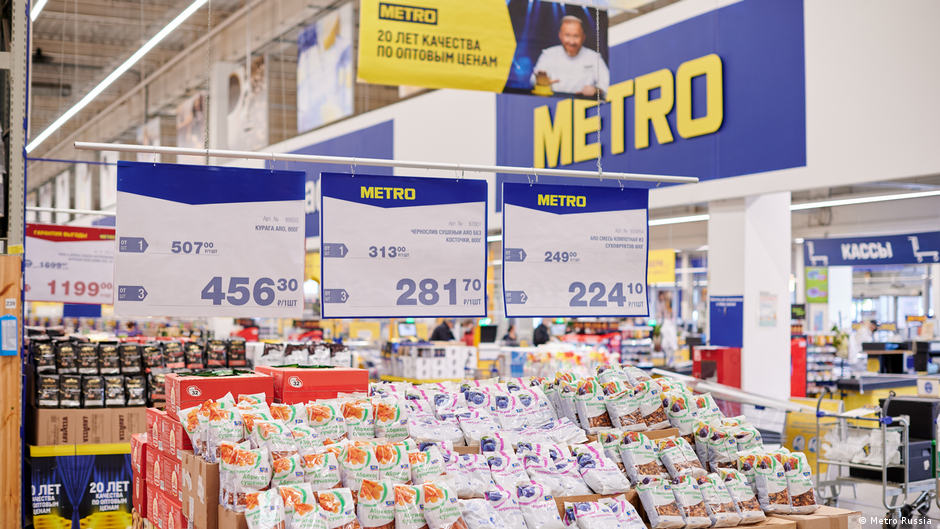
Foreign retail groups that remained exposed to the Russian market are facing a deepening loss of control over local assets, with some businesses already placed under temporary management and owners cut off from access to them. The cases involving French chains Auchan and Leroy Merlin, Germany’s Metro and other companies underline how corporate property, operational oversight and local governance have become central risks for international businesses still tied to Russia.
The central question is whether the Russian businesses of foreign retailers could face nationalization. The available facts point to a pattern in which foreign trading networks are being deprived, one after another, of the ability to manage their Russian assets directly. Temporary management has been introduced over assets linked to Auchan, Leroy Merlin, Metro and other companies. In practical terms, that means the owner may still be associated with the asset, but the ability to control day-to-day management is no longer in the owner’s hands.
For a publication focused on financial technology and the digital economy, the retail cases matter beyond the store floor. Large retail chains are deeply integrated with payments infrastructure, supplier finance, loyalty platforms, inventory software, banking relationships and digital customer data. When control over a retailer’s operating assets changes, the disruption is not only legal or political. It can affect settlement flows, vendor payments, treasury functions, card acquiring relationships, digital banking links and cybersecurity governance.
Temporary Management as a Financial Infrastructure Risk
Temporary management over retail assets changes the basic assumptions on which cross-border corporate finance depends. Foreign owners that lose access to Russian assets may also lose visibility into cash movement, payment obligations, technology systems and compliance controls. In retail, where revenue is generated through millions of consumer transactions, the question of who controls the business also becomes a question of who controls payment routing, financial reporting and platform access.
The cases of Auchan, Leroy Merlin and Metro show how foreign retailers can find themselves separated from assets that may still carry their corporate history, operational systems or commercial relationships. Even when a company’s local business is formally distinct from its parent, the financial and technology consequences can be broader. Payment service providers, banks, cybersecurity vendors and enterprise software suppliers may all need to assess who has authority over contracts and systems once temporary management is introduced.
Foreign trading networks are losing the ability to manage their Russian assets one after another, with temporary management imposed on assets of Auchan, Leroy Merlin, Metro and others.
The situation also highlights a broader challenge for multinational companies in politically exposed markets: asset ownership does not necessarily guarantee operational control. For fintech and digital banking providers, that distinction is critical. A retailer may continue operating stores, processing payments and maintaining supplier relationships, while the foreign owner no longer has the same access to management decisions, financial accounts or internal systems.
The Globus Case and the Search for Protection
Another notable development concerns the former Russian subsidiary of the German holding Globus. Former German chancellor Gerhard Schröder has joined the supervisory board of that former Russian unit. The move stands out because it suggests that some businesses or related entities may be seeking prominent figures as a form of governance cover or political protection as pressure on foreign-linked assets increases.
The Globus episode sits alongside the broader pattern affecting Western retailers in Russia. While the company’s former Russian subsidiary is not described in the same terms as the assets placed under temporary management, the appointment of Schröder to the supervisory board points to the importance of governance structures in the current environment. Supervisory boards, local management and public-facing figures may become part of how companies attempt to navigate risk when direct foreign control is politically vulnerable.
For investors and technology-sector analysts, the issue is not limited to traditional retail. Modern retailers operate as digital platforms: they process electronic payments, run customer databases, depend on cybersecurity controls, and connect to banks and vendors through automated systems. A shift in governance can therefore create operational uncertainty for companies providing payment terminals, fraud monitoring, cloud infrastructure, loyalty technology or digital banking services.
The potential threat of nationalization adds another layer of risk. Even the question of whether nationalization may occur can alter decision-making by banks, payment processors and technology partners. Companies may hesitate to extend credit, renew systems contracts or maintain software access if the identity of the controlling party becomes uncertain. In cross-border settings, compliance teams must also consider whether continued service could expose them to legal, sanctions or reputational risk.
Retail Assets as Digital Economy Nodes
The Russian businesses of foreign retailers are not isolated storefronts. They are nodes in a wider digital economy. Their operations touch card payments, payroll systems, consumer finance, logistics software, supplier portals and cybersecurity architecture. When foreign owners are deprived of access to these assets, the consequences can ripple through this ecosystem.
For technology stocks and listed companies with exposure to enterprise software, payments, logistics or retail banking, these developments reinforce the importance of geopolitical risk in revenue models. The facts from Russia show how quickly commercial infrastructure can be placed under new control arrangements. Investors evaluating companies with emerging-market exposure may need to pay closer attention to where digital revenue depends on legally secure access to local assets.
The immediate record is clear: assets linked to several Western retail groups in Russia, including Auchan, Leroy Merlin and Metro, have been placed under temporary management, with owners losing access to them. At the same time, the former Russian subsidiary of Globus has added Gerhard Schröder to its supervisory board. Together, these developments illustrate a shift from ordinary corporate management to a more defensive and politically sensitive model of operating in Russia.
For the fintech sector, the lesson is that retail control is also payments control, data control and systems control. As foreign retailers face temporary management and possible nationalization risk, the financial technology companies around them must treat governance instability as a core operational risk rather than a background political issue.