Kyiv Strike Kills Two as Energy Infrastructure Comes Under Renewed Pressure
Officials said missile debris hit multiple Kyiv districts, damaging a maternity hospital area as reports pointed to energy facilities as the main target.
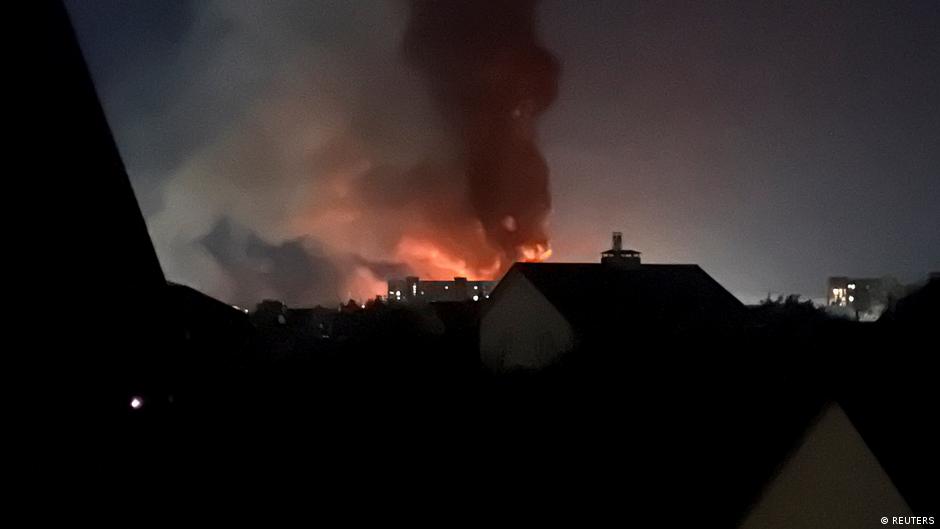
Two people were killed and six others were injured after Russian armed forces shelled Kyiv overnight into Thursday, September 24, according to Vitali Klitschko, the mayor of the Ukrainian capital. The attack damaged residential, administrative and medical-adjacent areas across several districts, including a parking area near a maternity hospital in the Podilskyi district.
Klitschko said on Telegram that two of the wounded were in serious condition. He reported missile debris in several parts of the city: on a roadway in the Darnytskyi district, on non-residential development sites in the Solomianskyi and Podilskyi districts, and in the Dniprovskyi district, where fragments landed in the courtyard of a 16-storey residential building, near private homes and on an administrative building.
The mayor said private residential properties were also affected and that one house sustained damage. In the Podilskyi district, missile debris struck a parking lot near a maternity hospital, setting cars on fire and damaging windows and part of the building’s facade. According to preliminary information cited by Klitschko, no one was injured inside the medical facility. He added that a nearby clinical and diagnostic center was also damaged.
“According to preliminary information, there were no casualties in the medical institution,” Klitschko said, referring to the maternity hospital area.
Energy Targeting Raises Digital Economy Risks
The reported scale and focus of the attack underscored the continuing vulnerability of urban infrastructure that supports Ukraine’s digital economy, from electronic payments and online banking to telecoms-dependent services and cybersecurity operations. Ukrainian Telegram channel Insider UA wrote that about 20 missiles of different types were launched at Kyiv over 35 minutes and that the main target of the attack was the electricity sector.
The source report did not provide details on outages, payment disruptions or direct damage to financial infrastructure. Still, attacks aimed at power systems are closely watched by banks, payment providers, crypto firms and technology companies operating in Ukraine because electricity reliability is a baseline condition for digital services. Even when banking networks are not directly hit, pressure on power supply can affect branch operations, ATMs, card terminals, mobile connectivity, data centers and the continuity planning that underpins real-time payments.
For fintech companies and digital banks, Kyiv remains a critical operating environment. The city is home to technology workers, corporate back offices, software vendors and financial services teams that depend on stable electricity and communications. Each attack on energy infrastructure can force companies to rely on backup systems, dispersed staffing and emergency protocols designed to keep consumer and business transactions moving.
The impact can extend beyond traditional finance. Ukraine’s digital economy includes remote technology teams, online commerce, cloud-based business services and users of digital assets who rely on functioning telecoms and secure devices. In wartime conditions, cybersecurity risks can also rise when organizations switch to contingency operations, staff work from improvised locations, or systems are restarted after power instability. The article did not report a cyberattack connected to the overnight strike, but the physical pressure on infrastructure adds to the operational burden already carried by technology and financial firms.
Medical and Residential Sites Damaged
The damage described by Klitschko was spread across several districts, suggesting a broad debris field from the strike. In Darnytskyi, he said a missile fragment fell onto a road. In Solomianskyi and Podilskyi, fragments landed on the grounds of non-residential developments. In Dniprovskyi, debris was reported near both apartment and private residential buildings, as well as on an administrative building.
The damage near the maternity hospital was among the most sensitive elements of the report. Klitschko said debris hit the parking lot by the facility, causing cars to catch fire. Windows and part of the facade were damaged, while a nearby clinical and diagnostic center also sustained damage. The mayor’s preliminary account said there were no casualties in the medical institution itself.
For digital health and public-service systems, damage to medical-adjacent infrastructure can carry additional operational significance. Hospitals and diagnostic centers depend not only on medical staff and physical equipment, but also on electronic records, scheduling platforms, payment systems, communications channels and power-backed emergency procedures. The report did not specify whether those systems were disrupted at the affected facilities.
Odessa Also Reports Damage
Separately, Serhiy Lysak, head of the Odessa city military administration, reported on Telegram that Russian armed forces had attacked Odessa. According to his account, medical and educational institutions were damaged, along with residential buildings.
“All relevant services are on site. Operational headquarters are being deployed to provide assistance to people,” Lysak wrote.
The Odessa report broadened the picture of overnight pressure on Ukrainian cities. As with Kyiv, the reported damage included civilian infrastructure, though the source text did not provide casualty figures for Odessa or specify whether energy, financial or telecoms assets were directly affected there.
For investors and operators tracking Ukraine’s technology and financial sectors, the latest reports point to a familiar wartime risk: physical attacks on infrastructure can quickly become digital-economy stress events. Power generation and distribution, mobile networks, payment acceptance, online banking access and cybersecurity resilience are interconnected. When one layer is hit, the effects can move through businesses and households even if the original target is outside the financial system.
The immediate confirmed toll in Kyiv stood at two dead and six injured, with two people in serious condition, according to Klitschko. The reported damage covered roads, residential courtyards, private homes, an administrative building, the area near a maternity hospital and a neighboring clinical and diagnostic center. Insider UA reported that roughly 20 missiles of various types were fired at Kyiv over a 35-minute period, identifying the electricity sector as the main target.