Ukraine Sanctions Organizers of Russian Duma Votes in Occupied Regions
Kyiv’s measures target 44 people linked to Russia’s parliamentary voting in occupied Ukrainian territories, with EU sanctions also under consideration.
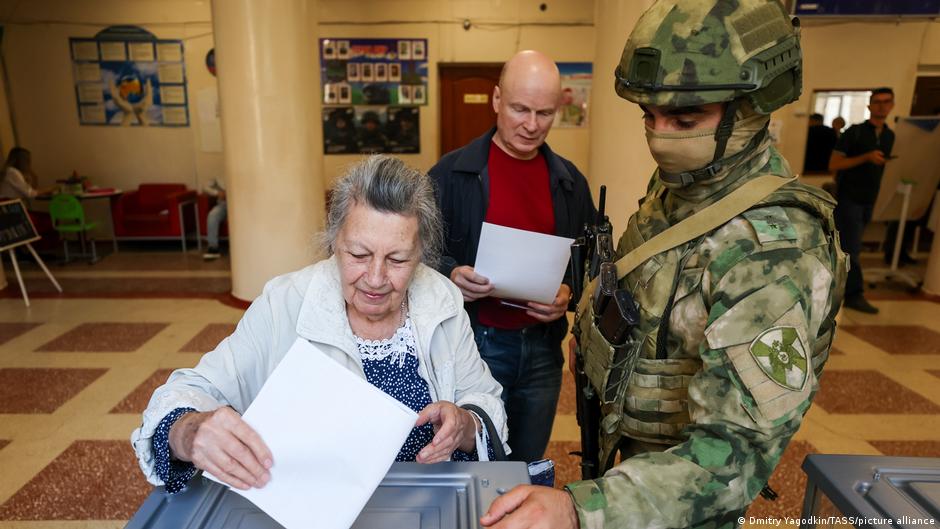
Ukrainian President Volodymyr Zelensky has imposed sanctions on individuals accused of helping organize elections to Russia’s State Duma in Ukrainian territories occupied by Moscow, a move that adds another layer of legal and compliance risk around Russia-linked political activity in contested regions.
The sanctions, introduced on Saturday, September 27, apply to 44 people. According to the Office of the President of Ukraine, 38 of those listed hold both Ukrainian and Russian citizenship. Ukrainian authorities said some of the sanctioned individuals had previously been “elected” as so-called deputies of illegally formed local councils in temporarily occupied parts of Ukraine.
The measures follow Russia’s State Duma elections, held from September 18 to 20. For the first time in a parliamentary election, Russian authorities organized voting in occupied areas of Ukraine’s Kherson, Zaporizhzhia, Donetsk and Luhansk regions.
Ukraine and its Western allies have declared both the process and its results illegal. The European Union has also said it is ready to introduce sanctions against people who assisted in holding the votes in occupied Ukrainian territories.
Ukraine and its Western allies have recognized the voting process and its results as illegal.
Sanctions Add Compliance Pressure
For financial institutions, payment providers, crypto platforms and digital banking firms, the latest Ukrainian sanctions underline the continued expansion of politically sensitive compliance obligations tied to Russia’s war against Ukraine. While the measures are directed at individuals accused of involvement in the voting process, they may have practical consequences for account screening, transaction monitoring and sanctions risk assessments.
Sanctions lists increasingly affect how banks, fintechs and exchanges handle customers with links to Russia-controlled structures or occupied territories. Even where Ukrainian measures do not automatically apply in every jurisdiction, they can influence risk models used by international banks, correspondent banking networks and compliance teams operating across Europe and other allied markets.
The potential involvement of people with dual Ukrainian and Russian citizenship may also complicate identity verification. Digital banks and payment companies often rely on customer data, residency records, government identifiers and sanctions databases to detect restricted users. When individuals have multiple citizenships or operate through local administrations not recognized by Kyiv or its allies, compliance teams may face greater difficulty distinguishing lawful activity from exposure to sanctioned networks.
Crypto platforms could face similar scrutiny. Exchanges and wallet providers are already expected in many jurisdictions to monitor sanctioned persons, high-risk geographies and possible attempts to move funds through digital assets. The inclusion of figures linked to occupation administrations may heighten attention on blockchain analytics and controls designed to prevent sanctioned individuals from accessing digital finance infrastructure.
Occupied Regions Given Separate Districts
For the 2026 State Duma elections, Russian authorities for the first time created separate single-member constituencies for Ukrainian regions occupied after 2022. After the vote, Russia declared several candidates elected from these districts.
In the so-called “DNR,” Russia announced the election of First Channel war correspondent Irina Kuksenkova and Alexander Borodai, the former “head” of the self-proclaimed republic. In the so-called “LNR,” Russia named local parliament “deputies” Denis Kolesnikov and Ivan Sanayev as elected. In occupied areas of Zaporizhzhia region, Russia declared Alexei Tikhomirov elected, and in Kherson region, Elena Dmitruk, described as a deputy chair of the local parliament, was announced as elected. All of them ran as candidates of United Russia.
In addition to candidates elected through single-member districts, another eight representatives of the “authorities” in occupied Ukrainian territories entered the Russian State Duma through federal party lists. Among them was Serhiy Arbuzov, a former first deputy prime minister of Ukraine under President Viktor Yanukovych and former head of the National Bank of Ukraine. He was nominated by the A Just Russia party.
Digital Economy Exposure
The sanctions decision is not aimed specifically at technology companies, but its relevance to the digital economy is direct. Modern sanctions enforcement depends heavily on databases, identity systems, payment rails and automated screening tools. Each new designation can require updates across banking platforms, card processors, remittance services, securities firms, crypto exchanges and compliance vendors.
Technology stocks with exposure to banking software, cybersecurity, digital identity and sanctions-screening services can be indirectly affected by geopolitical events of this kind. Demand for compliance infrastructure tends to rise as sanctions regimes become more complex. At the same time, companies operating in or near affected markets may face higher operational, legal and reputational risks.
Cybersecurity is also part of the wider picture. Elections in occupied territories, disputed administrative systems and sanctions enforcement all create sensitive data environments. Banks and fintech firms handling customers from affected regions may need to guard against identity manipulation, forged documentation, account takeovers or attempts to evade restrictions through intermediaries.
The latest Ukrainian measures therefore extend beyond a political statement. They reinforce a sanctions environment in which digital finance companies must track fast-moving geopolitical designations, assess exposure to occupied territories and maintain controls capable of identifying restricted individuals across borders and platforms.