Germany Links Ukraine Support to Domestic Defense Industry Participation
Foreign Minister Johann Wadephul said German defense firms should benefit from Berlin’s financial and military backing for Kyiv.
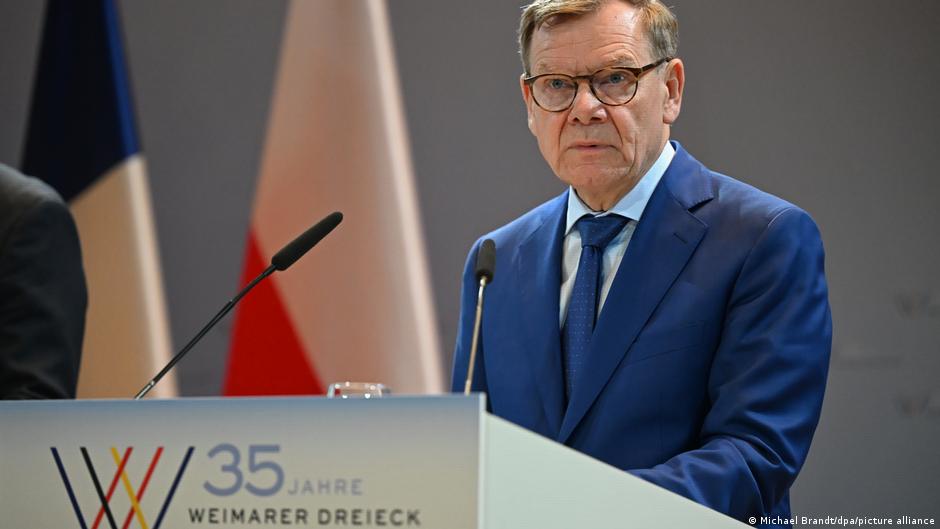
German Foreign Minister Johann Wadephul has criticized Ukrainian President Volodymyr Zelensky and urged Kyiv to pay closer attention to Germany’s interests, tying Berlin’s continued support for Ukraine to a stronger role for German defense companies in procurement linked to that assistance.
In an interview with Bild published on Tuesday, September 8, Wadephul said Germany is currently Ukraine’s strongest supporter in terms of financial and military aid. He argued that, as a result, German industry should have a clearer place in the spending and supply chains associated with that support.
“At the moment we are Ukraine’s strongest supporter in terms of financial and military support,” Wadephul said, adding that “naturally, the German defense industry must benefit from this.”
The comments place procurement, industrial participation and taxpayer accountability at the center of Germany’s Ukraine policy. For financial markets and the digital economy, the statement also underscores a broader shift in European public spending: defense support is increasingly being framed not only as foreign policy, but also as an industrial and investment channel with consequences for suppliers, payment flows, cybersecurity systems and listed technology-linked defense companies.
Procurement Conditions Move Into Focus
Wadephul said he raised the issue directly with Zelensky during a recent visit to Kyiv. According to his account, he told the Ukrainian side that Germany remains on Ukraine’s side and continues to provide support, but that he must also explain the policy to German taxpayers.
He said that, at a minimum, German defense industry should be involved in all procurements. That formulation is significant because it points to a more explicit connection between aid commitments and commercial participation by companies in the donor country. In practical terms, it suggests that Berlin wants Ukrainian procurement decisions linked to German-backed assistance to include German suppliers, rather than treating support as detached from domestic industrial interests.
For the fintech and payments sector, large state-backed procurement programs tend to involve complex cross-border settlement, compliance checks, bank guarantees, export controls and supplier verification. Wadephul did not discuss payment systems or financial technology directly, and no details were given about the mechanisms through which procurement would be handled. Still, his emphasis on taxpayer accountability and participation in all purchases highlights the importance of traceable financial flows and auditable contracting in future Ukraine-related support.
Germany has been one of Kyiv’s key backers since Russia’s full-scale war against Ukraine began, and Wadephul’s language indicates that Berlin wants the economic benefits of that support to be more visible at home. The political message is aimed at both Kyiv and German voters: Germany will continue helping Ukraine, but domestic industry should not be left outside the resulting procurement cycle.
Additional Aid Announced in Kyiv
Wadephul visited Kyiv on August 22. During a joint press conference with Ukrainian Foreign Minister Andrii Sybiha, he announced an additional 60 million euros in assistance for Ukraine.
Germany will also transfer another 10 million euros to a NATO fund. According to Wadephul, money from that fund is used, among other things, for supplies of energy carriers, medical equipment and systems for protection against drones.
Those categories show how Ukraine-related support increasingly spans military, energy, health and security infrastructure. Energy supplies and anti-drone protection are not only defense issues; they also affect the resilience of digital banking, electronic payments, data centers, communications infrastructure and other parts of the digital economy that depend on stable power and secure operating environments.
Wadephul also announced further talks with partners from various countries on supplying Ukraine with additional air defense systems. Air defense has become a central issue for Ukraine’s ability to protect cities, energy networks and critical infrastructure. While the minister did not name specific systems or provide figures beyond the announced aid amounts, his remarks indicate that Berlin will continue working with international partners on further deliveries.
For investors, the remarks may add attention to European defense contractors and technology suppliers involved in air defense, drone protection, logistics, secure communications and infrastructure resilience. The source statement did not identify any companies, stocks or contracts. But the policy signal is clear: German officials are looking at Ukraine assistance through the lens of national industrial participation as well as strategic support.
Taxpayer Accountability and Market Signals
Wadephul’s argument rests on a political calculation that has financial implications. If Germany is providing major financial and military support, he said, German taxpayers must be able to see how that policy aligns with German interests. That creates pressure for clearer procurement rules, stronger documentation and visible domestic economic returns.
In the digital economy, such pressure often translates into demand for systems that can track public funds, verify vendors, monitor contracts and reduce fraud risk. The article does not state that Germany or Ukraine will introduce new fintech tools, blockchain systems or digital procurement platforms. However, the underlying issue Wadephul raised is one that modern public finance increasingly confronts: how to move large sums quickly while maintaining transparency, compliance and public trust.
The crypto market is not directly mentioned in Wadephul’s remarks, and there is no indication from the source that cryptocurrency is involved in the aid flows. Still, the broader policy environment matters for digital finance because wartime funding, sanctions compliance, NATO-linked funds and cross-border transfers all increase scrutiny of financial channels. Banks, payment providers and compliance technology firms are likely to remain central to any system that handles government-backed procurement and aid disbursement.
Wadephul’s comments also come at a time when European governments are weighing how to support Ukraine while strengthening their own defense industrial bases. His message to Kyiv was blunt: Germany supports Ukraine, but German interests, including those of its defense sector, should receive more attention in procurement decisions. For FinPulse readers, the key takeaway is that defense aid is becoming part of a larger economic architecture, linking public budgets, industrial policy, technology suppliers, payment infrastructure and market expectations around European security spending.